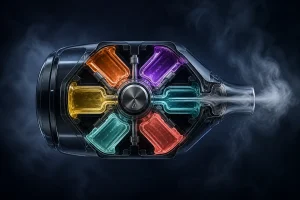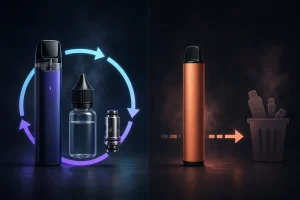
MTL vs DTL describes two different ways that vapour moves through the mouth and lungs. Mouth-to-lung uses a tighter, two-stage draw; direct-to-lung uses a more open draw directly into the lungs. However, neither style is automatically better or safer. Ultimately, the useful choice depends on the device design, airflow, coil, output, liquid and the adult user’s existing preference.
MTL
Vapour enters the mouth first, and then the user inhales it. The draw is usually tighter, with less airflow and less vapour per puff.
DTL
The user inhales vapour directly with a more open draw. Compatible setups usually use more airflow and produce more vapour.
RDL
Restricted direct lung sits between the two: more open than typical MTL, but more restricted than a full DTL draw.
MTL vs DTL at a glance
| Dimension | MTL | DTL |
|---|---|---|
| Inhalation path | Mouth first, then lungs | Directly into lungs |
| Typical airflow | Tighter | More open |
| Typical vapour volume | Lower | Higher |
| Typical output | Lower | Higher |
| Liquid use per draw | Often lower | Often higher |
| Common device feel | Restricted, cigarette-like draw | Airier, larger-volume draw |
| Important caveat | Not every tight device is suitable for every liquid/strength | Not every open device is designed for high output |
“Typical” matters in this table. Adjustable airflow, different coils and changing power can move the experience toward RDL or change it substantially. Always stay within the exact coil and device instructions.
What is MTL vaping?
The MTL vape meaning is “mouth to lung.” The user draws vapour into the mouth, pauses briefly, then inhales. Manufacturers often pair this style with a narrower airflow path and lower-output setup.
For example, MTL may suit an adult user who prefers a restrained draw, less vapour or a familiar two-stage inhalation. However, appearance alone cannot confirm MTL. A slim mouthpiece may still connect to adjustable hardware, while a large device may offer a restricted mode.
Usually tighter airflow and a controlled draw; exact output and nicotine suitability remain product-specific.
What is DTL vaping?
DTL means “direct to lung.” Vapour moves directly into the lungs in one open inhalation. Compatible DTL devices usually use more airflow and higher output, which can create more vapour and consume more liquid per draw.
Likewise, an adult user may prefer DTL for an airier draw or larger vapour volume. That does not mean every adjustable vape can safely become a DTL device. The coil, power range, airflow and liquid configuration must all support the selected mode.
Usually more open airflow and more vapour; use only a setup documented for that draw and output.
The five variables behind DTL vs MTL
The inhalation label is only one part of the experience. In practice, five variables work together:
A tighter inlet increases resistance; a wider opening supports a more open draw.
Resistance and construction affect the intended output and vapour delivery.
More power generally means more heat and liquid use, but only within the supported range.
Liquid composition and labelled nicotine strength must fit both the product and local rules.
Draw length and force change vapour volume and perceived intensity.
This is why changing one airflow switch does not always convert a device from MTL to DTL. A product may offer several draw settings, but each setting still depends on the installed heating system.
Does MTL or DTL feel more intense?
There is no universal answer. Perceived throat hit or intensity can change with nicotine concentration, flavour, cooling level, airflow, vapour volume, coil, power and individual technique. Even so, a smaller cloud can still feel strong if other variables change.
In one SiloVape support record dated 12 April 2026, an MRVI 25000 customer said the sensation became too strong after switching to MTL mode. However, the customer withdrew the case after submitting it to MRVI, so SiloVape could not recover the device or reproduce the issue. The support record did not preserve nicotine, flavour, airflow or batch details.
At present, SiloVape holds only the latest described “optimised” batch, but no controlled comparison shows that the manufacturer fixed a specific issue. Therefore, the case serves only as a reminder to check all variables; it does not show that MTL is inherently harsher or that MRVI 25K has a general defect.
Manufacturers often position MTL with higher labelled nicotine strengths and DTL with lower strengths, but this is not a personal dosing recommendation. Check the exact label, product instructions and destination-market limit. Stop if the experience is unexpectedly strong.
MTL vs DTL product examples—with limits
For example, local product data helps illustrate positioning, but it cannot replace a real draw test.
| Positioning example | Retained fields | What it illustrates | Limitation |
|---|---|---|---|
| FIHP Crystal Promax 12000 | MTL category, 1.0Ω, 650 mAh | A documented MTL-positioned product | Classification does not measure actual draw resistance |
| JNR AeroX 32000 | MTL, adjustable airflow, refillable pod, dual mesh | How airflow and pod format can overlap | Exact settings require the model manual |
| VOZOL Gear 50000 | MTL, adjustable airflow, triple heating structure | A control-rich MTL-positioned example | Not a destination-market recommendation |
| JNR Shisha Hookah Max 22000 | DTL, adjustable airflow, triple mesh | A DTL/e-shisha positioning example | Manifest lacks measured airflow and power |
| UOR Al Bang 300K | MTL and DTL tags, adjustable airflow | A claimed mixed-mode device | Needs physical and manual verification before describing the transition |
AL WAHA and ATVS e-shisha manifests contain 3 mg entries, but the manifests do not confirm the full unit. Therefore, do not use these entries for a nicotine comparison until the label verifies whether the value means mg/ml.
Which style suits you?
MTL may suit you if you prefer…
- A tighter draw
- Less vapour per puff
- A two-stage mouth-then-lung action
- A compact, controlled experience
DTL may suit you if you prefer…
- A more open draw
- More vapour volume
- A direct inhalation action
- A setup designed for higher airflow/output
RDL may suit you if you prefer…
- More airflow than MTL
- More restriction than full DTL
- A middle-ground draw
- Adjustability within a supported setup
The first-time guide to using a vape explains safe setup before experimenting with an adjustable device. For product discovery, use the dedicated MTL device collection or DTL device collection only after confirming the market version and live specifications.
MTL vs DTL FAQ
Is MTL the same as a disposable vape?
No. MTL is an inhalation style. Disposable, refillable and pod-system products may be positioned for MTL depending on their design.
Can one vape support both MTL and DTL?
Some devices claim adjustable or mixed draw modes. Confirm the airflow, installed coil and supported power range in the exact manual rather than relying on a category tag.
Does DTL use more e-liquid?
A more open, higher-output draw often uses more liquid per puff, but actual consumption depends on power, coil, draw length and frequency.
Is one style safer?
This comparison does not establish a safety advantage. Both must be used within the product instructions, and health questions require qualified professional advice.
Conclusion
Ultimately, the practical MTL vs DTL decision comes down to draw preference and compatible hardware. MTL is usually tighter and two-stage; DTL is usually more open and direct; RDL fills the middle. Check airflow, coil, power, liquid and label together, because no single switch or product shape tells the whole story.
Sources and editorial method
Facts and local manifests were checked on 18 August 2026. Product examples show retained positioning only. No draw-resistance measurements or controlled product comparison were available, and the MRVI example is one unresolved support case.